
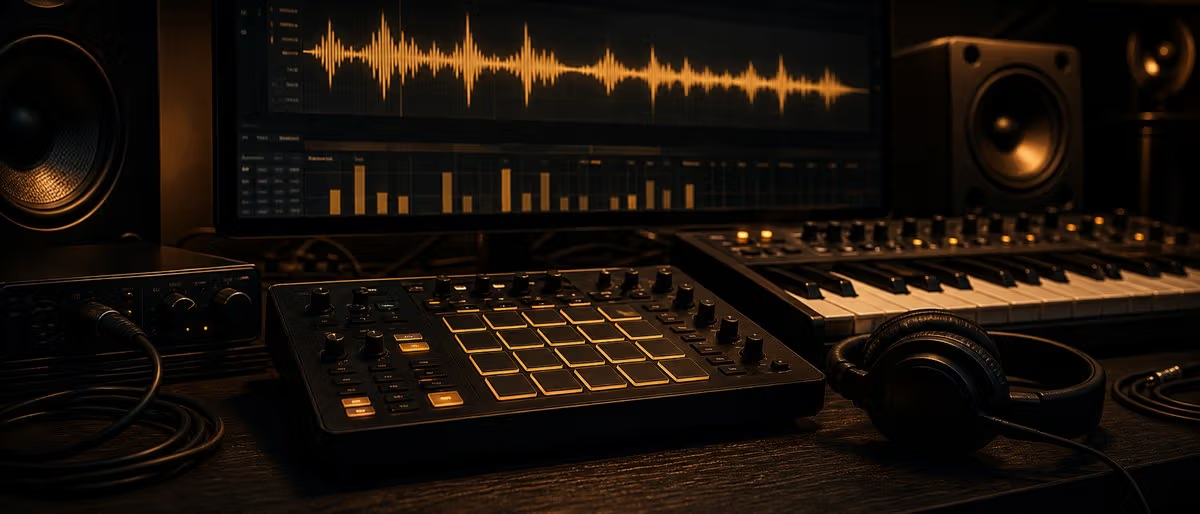
What Is Phonk Music? Origins and Evolution
Phonk emerged in the early 2010s as a lo-fi, gritty offshoot of Memphis rap. Producers like DJ Smokey, Soudiere, and Mythic crafted dark, sample-heavy beats using vintage Memphis acapellas, pitched-down vocals, and heavy 808 distortion. The sound was characterized by tape saturation, vinyl crackle, and a murky, almost horror-film atmosphere. By 2020, a faster, more aggressive subgenre called Drift Phonk exploded on TikTok and in car culture. Drift phonk uses cowbell melodies (a nod to Brazilian funk), distorted kicks at 150-170 BPM, and loud, sidechained 808s. House Phonk blends the phonk aesthetic with four-on-the-floor house beats. Brazilian Phonk incorporates Brazilian funk percussion (tamborzão), aggressive vocals, and even faster tempos. Rare Phonk stays closest to the original style: slow (100-120 BPM), sample-heavy, atmospheric, and lo-fi.
Drum Patterns: From Old School to Drift
Phonk drum programming varies by subgenre. Classic/Rare Phonk (100-120 BPM): slow, swinging drums. Kick on 1 and 3, snare on 2 and 4 (the classic boom-bap pattern). Use 1/8 hi-hats with heavy swing (60-70%). Layer a rimshot or side-stick with the snare for texture. Add occasional open hats and shaker loops. Drift Phonk (150-170 BPM): fast, relentless kicks — often four-on-the-floor or off-beat patterns. Snare/clap on 2 and 4 (with a double-time feel) or on every beat for maximum energy. Hi-hats play 1/16 or 1/32 note rolls with strong velocity variation. Cowbell is the defining element: it plays a syncopated rhythm, often following the kick pattern. House Phonk (120-130 BPM): four-on-the-floor kick, clap on 2 and 4, open hat on the off-beats. Add phonk cowbell melodies and vocal samples on top of the house foundation. Brazilian Phonk (130-150 BPM): layered percussion with tamborzão (the Brazilian funk drum pattern), agogo bells, and fast kicks.
Cowbell Melodies: The Signature Phonk Sound
The cowbell is the most recognizable element in drift phonk. Sound selection: use a synthetic cowbell or an FM bell with a short decay. Layer two cowbell sounds — one bright (2-4 kHz) and one lower (800 Hz-1.5 kHz) — for a rich tone. Pitch the higher one up by 7-12 semitones. Building the pattern: cowbell melodies are usually simple, 1-2 bar loops of 3-5 notes. Use the harmonic minor scale for a dark, ominous feel. Common patterns: playing on every 1/8 note with alternating pitches, or creating a syncopated rhythm with 1/16 notes. Processing: add saturation/distortion (Softube Saturation Knob, CamelCrusher, or Decapitator). EQ: boost 3-5 kHz for presence, high-pass at 300 Hz. Add a short reverb (0.5-1.0s decay, small room) to place the cowbell in the space. Compress with a fast attack for even, punchy transients. Key tip: the cowbell should sit slightly behind the kick and 808 in the mix — it's an atmospheric element, not a lead instrument.
Memphis Vocal Samples and Processing
Phonk's vocal identity comes from classic Memphis acapellas — artists like Three 6 Mafia, Tommy Wright III, and Kingpin Skinny Pimp. Sourcing: find acapella packs online or extract vocals from old tracks using AI separation (Logic Stem Splitter, iZotope RX, lalal.ai). Processing chain: pitch the vocal down 3-7 semitones for a deeper, more menacing tone. Add tape saturation/wow & flutter (RC-20 Retro Color, Waves J37, or your DAW's stock tape emulation). EQ: cut below 300 Hz and above 8 kHz — phonk vocals should sound like they're coming through an old cassette. Add a slap delay (1/8 note, 15-20% feedback, filtered). Reverb: a short room or plate, low send level (10-15%). Placement: vocal chops in the intro and between sections. Use short phrases (1-2 seconds) as ear candy. The key is restraint: one well-placed vocal chop is more effective than constant chatter.
Mixing Phonk: Distorted, Loud, and Controlled
Phonk mixes prioritize distorted 808s and aggressive kicks. 808 processing: apply heavy saturation (CamelCrusher, Decapitator, or Softube Saturation Knob with plenty of drive). Compress with a medium attack and fast release (2-4 dB of reduction). Use a soft clipper on the 808 channel for loudness. Kick processing: layer a punchy kick on top of the 808. EQ: boost 60-80 Hz for the sub, 2-5 kHz for the click of the attack. Sidechain the 808 to the kick for clarity. Overall mix: phonk mixes are loud — aim for -8 to -5 LUFS integrated. Achieve this through soft clipping at the track level and master-bus limiting. Stereo width: keep the kick and 808 strictly in mono. The cowbell can be slightly wide (10-30% pan spread). Vocal samples and atmosphere: 100% width. Mixing tip: phonk thrives on harmonic distortion — use several stages of subtle saturation instead of one heavy distortion. This creates richness without harshness.
دليل خطوة بخطوة
- خطوة 1: Choose your phonk style and BPM
Decide: Drift Phonk (150-165 BPM, cowbell-based), Rare Phonk (100-120 BPM, sample-based), House Phonk (120-130 BPM, four-on-the-floor), or Brazilian Phonk (130-150 BPM, percussion-heavy). Set your DAW tempo accordingly. - خطوة 2: Build the drum foundation
For drift phonk: program a fast kick pattern, snare on 2 and 4, and 1/16-note hi-hats with velocity variation. For rare phonk: a slow boom-bap kick/snare with swinging hi-hats. Add an open hat for accent. Use heavy compression and soft clipping on the drum bus. - خطوة 3: Create the cowbell melody
Load a cowbell sound or an FM bell. Create a simple 2-bar melody of 3-5 notes in harmonic minor. Process it with saturation, EQ (boost 3-5 kHz), and a short reverb. The cowbell should be prominent but not overpowering — it's a texture, not a lead. - خطوة 4: Add vocal samples and atmosphere
Import a Memphis rap acapella. Pitch it down 3-7 semitones. Apply tape saturation, a low-pass filter around 8 kHz, and a slap delay. Place chops in the intro and between sections. Add ambient noise (rain, vinyl crackle) for atmosphere. - خطوة 5: Program the 808 and mix
Load a distorted 808 sample. Program a bassline that follows the root notes of your cowbell melody. Apply heavy saturation and soft clipping. Mixing: aggressively soft-clip individual tracks, check mono compatibility, and limit the master to -8 to -5 LUFS.
Download free phonk drum kits, 808 samples, and cowbell packs — everything for authentic phonk production.
تصفح التنزيلات المجانيةLearning path
مراكز إجابات ذات صلة
تغذية النوع
Phonk المواد من الخلاصة
الحلقات واللقطات الواحدة والإعدادات المسبقة وإسقاطات الكتالوج التي تتوافق مع مسار الإنتاج Phonk.


مقالات ذات صلة


الأسئلة الشائعة
- What's the difference between drift phonk and regular phonk?
- Drift phonk is faster (150-170 BPM), leans heavily on cowbell melodies, features distorted kicks, and is built for high-energy contexts like drift videos and gym content. Regular phonk (rare phonk) is slower (100-120 BPM), sample-heavy, atmospheric, and more lo-fi — closer to the original Memphis sound of the 2010s. Drift phonk was born on TikTok; rare phonk was born on SoundCloud.
- Where can I find Memphis rap vocal samples for phonk?
- Look for Memphis rap acapella packs on sample sites and forums. Artists like Three 6 Mafia, Tommy Wright III, Project Pat, and Koopsta Knicca have widely available acapellas. You can also extract vocals using AI stem separation (lalal.ai, iZotope RX, Logic Pro Stem Splitter). Respect copyright — use short, transformative chops rather than full verses.
- What are the best plugins for phonk production?
- Essential free plugins: CamelCrusher (distortion/compression — the backbone of phonk), Softube Saturation Knob, TAL-Reverb-2, OTT (multiband compression), Krush (bitcrusher), and Izotope Vinyl (free, for lo-fi texture). Paid favorites: RC-20 Retro Color (tape/vinyl emulation), Decapitator (saturation), ValhallaVintageVerb (reverb), and Serum/Vital (cowbell synthesis).
- How do you make phonk 808s distorted but clean?
- Use several stages of subtle saturation instead of one heavy distortion. The chain: EQ (cut below 30 Hz) → Saturation stage 1 (warm, tape-style) → Saturation stage 2 (tube or British-style, with heavier drive) → Soft clipper. Between stages, use gentle compression (2-3 dB of reduction) to control peaks. The result is harmonically rich but not harsh — you hear the character of the distortion without losing sub-bass…